


LEW
Administrator
Staff member
A data-driven approach to peptide investigation. Beyond the research papers. Beyond the claims. Beyond "it felt great."
Most peptide reports online come down to one sentence: "I took it and slept better." Mine don't.
Every investigation I publish is run as a structured N-of-1 experiment: a formal single-subject study with a defined protocol, a measured baseline, statistical comparison, a blinded personal assessment, a confounder audit and an honest evidence rating. I'm a 55-year-old competitive cyclist with years of continuous physiological tracking behind me, and I bring all of it to every peptide I investigate.
I don't ask "did it feel good?" I ask "is this result genuinely outside my normal range, and what else could explain it?"
I then compare my subjective experience with the objective data, point by point: where they agree, where they conflict, and why.
My objective is not to prove that a peptide works. It's to find out whether the evidence genuinely supports the claims being made, and to show my working so you can judge it for yourself.
That means I publish:
What carefully designed N-of-1 research can do is show whether an effect is large and consistent enough to be worth taking seriously, generate sharper questions, and add real-world context to the published science. Where a signal appears, the next step is replication: repeated exposures, ideally blinded on/off comparisons, to see whether it holds.
Measure carefully. Establish the baseline. Challenge every result. Report what the data actually shows, not what we hope to find.
Independent Peptide Research · Structured N-of-1 Experimentation · Physiological Data Analysis · Cycling Performance & Recovery Science · Evidence-Led Investigation
Most peptide reports online come down to one sentence: "I took it and slept better." Mine don't.
Every investigation I publish is run as a structured N-of-1 experiment: a formal single-subject study with a defined protocol, a measured baseline, statistical comparison, a blinded personal assessment, a confounder audit and an honest evidence rating. I'm a 55-year-old competitive cyclist with years of continuous physiological tracking behind me, and I bring all of it to every peptide I investigate.
I don't ask "did it feel good?" I ask "is this result genuinely outside my normal range, and what else could explain it?"
What I measure
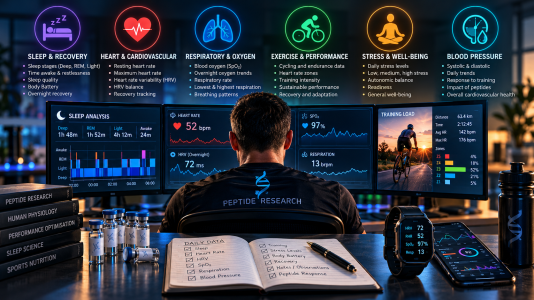
I monitor and record a large set of physiological and performance indicators across several platforms, including Garmin Connect, a Garmin Edge 1040, Zwift, ZwiftPower, ZwiftRacing.app and Strava. Each experiment draws on dozens of variables:- Sleep architecture: deep, REM, light and awake time in minutes and as a share of the night; restless moments; sleep onset and wake timing; sleep score and its sub-factors; sleep efficiency.
- Autonomic and cardiovascular: overnight HRV, 7-day HRV average and status, peak 5-minute HRV, resting heart rate, average overnight heart rate, heart-rate zones and post-exercise recovery.
- Recovery and energy: Body Battery charge and drain, overnight stress, training readiness and recovery time.
- Respiratory: average and lowest respiration rate, overnight SpO₂ and minimum SpO₂, breathing variations.
- Cycling performance: power output, FTP and zFTP, watts per kilogram, power-duration records from 5 seconds to 60 minutes, race results, training load, heart rate at fixed power, and aerobic decoupling.
- Broader health indicators: blood pressure, fatigue, readiness and general well-being.
How every experiment is run
1. Baseline first, always
Before an intervention is assessed, I establish my normal range from the nights immediately before it: at minimum a 7-night baseline, and longer where the data allows. For every metric I calculate the arithmetic mean, median, standard deviation, range and coefficient of variation, so I know not just my average but how much each measure naturally swings from night to night.2. Exact numbers, not impressions
Every metric is compared against baseline using:- Absolute and percentage change
- Percentage points vs relative change for proportions. A deep-sleep share rising from 19% to 34% is +15.2 percentage points, not just "+80%."
- Standardised deviation (z-scores), which shows how many standard deviations a result sits from my normal
- Empirical rank, which shows where the night falls among every night in the comparison
3. Derived metrics that reveal more
Where the inputs exist, I calculate measures the devices don't show me directly: Body Battery recharge per hour of sleep, restlessness per hour, HRV-to-resting-heart-rate ratio, stage proportions and sleep efficiency. These help separate "slept longer" from "slept better."4. Stress-testing every result
A number that looks impressive isn't accepted at face value. Each finding is challenged with:- Sensitivity analysis: does the result survive if an unusual baseline night is removed?
- Trend checks: was the metric already rising before the intervention? A higher HRV means little if it was climbing all week anyway.
- Matched-condition comparisons: comparing against baseline nights with similar circumstances, such as nights after equally hard races, so training doesn't masquerade as a peptide effect.
- Multiple-comparison awareness: when 28 metrics are compared, one or two will look unusual by chance alone. I account for that.
- No double-counting: related metrics that move together, such as deep sleep and stillness, are counted as one signal, not stacked up as several independent "wins."
5. Blinded personal assessment
How I feel matters, so it's measured properly. After the experimental data is collected but before I see any results, I complete a structured 13-question sleep and recovery interview. It covers perceived quality, sleep onset, night waking, continuity, depth, dreams, refreshment, energy, mood, side effects and physical recovery, each scored and compared with my normal experience. Seeing the numbers first would bias my answers, so I don't.I then compare my subjective experience with the objective data, point by point: where they agree, where they conflict, and why.
6. A full confounder audit
Every experiment records the factors that could produce the same effect:- Dose timing and route
- Training load, intensity and timing (pulled directly from my ride files)
- Caffeine and alcohol
- Bedtime and meal timing
- Stress, illness, room conditions and fluid intake
7. Data-quality auditing
Wearables aren't perfect, and I don't pretend they are. I reconcile sleep stages against total sleep, check for missing or partial recordings, and flag device limitations. In my first experiment, this process caught a two-hour gap at the start of the night, which I reported prominently rather than letting it inflate or distort the conclusions.8. Honest evidence ratings
Every finding is classified as favourable, unfavourable, neutral or ambiguous. The evidence for a genuine intervention effect is then rated separately as insufficient, suggestive or strong. A single night will rarely get past "suggestive," however good it looks, and I say so.9. Full documentation
Each experiment produces a complete research record covering the protocol, baseline data, every calculation, the subjective interview, confounders, conclusions and unresolved questions. All of it is archived, so later experiments can be compared directly against earlier ones.Why this matters for peptide research
The real challenge isn't measuring a change. It's working out what caused it. Sleep, training, nutrition, stress, illness, expectation and ordinary night-to-night variation can all move the same numbers a peptide might.My objective is not to prove that a peptide works. It's to find out whether the evidence genuinely supports the claims being made, and to show my working so you can judge it for yourself.
That means I publish:
- Results that support the hypothesis, and results that don't
- Adverse effects, however minor
- Data gaps and measurement problems
- The alternative explanations I couldn't rule out
The limits I'm open about
Personal monitoring can't establish clinical effectiveness, prove causation or replace controlled human trials. Consumer wearables have real measurement limitations, especially in distinguishing sleep stages. A single-subject study tells you about one person.What carefully designed N-of-1 research can do is show whether an effect is large and consistent enough to be worth taking seriously, generate sharper questions, and add real-world context to the published science. Where a signal appears, the next step is replication: repeated exposures, ideally blinded on/off comparisons, to see whether it holds.
Measure carefully. Establish the baseline. Challenge every result. Report what the data actually shows, not what we hope to find.
Independent Peptide Research · Structured N-of-1 Experimentation · Physiological Data Analysis · Cycling Performance & Recovery Science · Evidence-Led Investigation