BIOMETRIC LAB: Experiment 001 — DSIP + Epitalon
22 Oct 2026 ·
@LEW
Personal N-of-1 research · 55-year-old cyclist (Zwift racer) · Garmin data
Read this first: a data gap that affects the results
I went to bed at about
23:00 and believe I fell asleep within 30 minutes, but Garmin didn't start recording sleep until
01:11. Both the HRV Status and Body Battery pages flagged "Missing Sleep Data", and Pulse Ox recorded nothing. Roughly
1.5–2 hours at the start of the night were probably not captured.
Why it matters:
- Total sleep (5h48) is probably undercounted. My real total was likely around 7–7.5 h, which fits sleeping until my alarm.
- Deep sleep usually happens mostly in the first 1–2 sleep cycles. If those are missing, the 1h59 of deep sleep came only from the later part of the night, which makes it either more unusual or a tracking artefact.
- Sleep score, onset time and stage minutes are all affected by the gap.
The experiment
| Item | Detail |
|---|
| Intervention | DSIP 500 mcg + Epitalon 4 mg (combined exposure) |
| Route and timing | Subcutaneous pen, both together, ~40 min before bed (≈22:20) |
| Prior use | First time ever for both |
| Test night | 21–22 Oct 2026 |
| Baseline | 7 nights, 14–15 to 20–21 Oct; n = 7 per metric; 0% missing |
| Design | Single open-label night vs the 7-night arithmetic mean; full sleep interview completed before seeing any results |
Because both peptides were taken together, any effect belongs to the combination. It can't be split between them.
Baseline check
- Stage minutes reconcile exactly with total sleep on all 8 nights.
- The test night is excluded from the baseline.
- One baseline outlier (14–15 Oct: score 45, 70 min awake, HRV 29) was checked with a 6-night sensitivity analysis, and the conclusions didn't change.
- HRV rose steadily through the baseline week (29 → 37 → 39 → 49 → 50 → 55 → 49 ms), so HRV is judged against that trend as well as the mean.
Full comparison: WITHOUT peptide vs WITH peptide
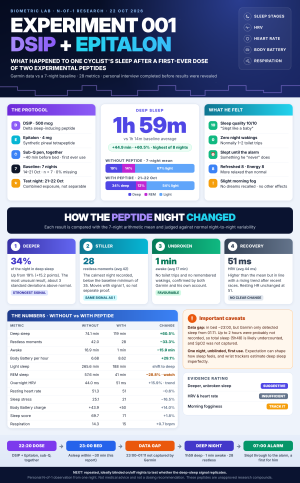
Deep sleep rose to 1h59 (+60.5%), the one result well outside my normal range; most other metrics sat within ordinary night-to-night variation. z = standard deviations from my baseline mean; rank = position among all 8 nights.
| Metric | WITHOUT (7-night mean) | WITH (test night) | Change | % | z / rank | Interpretation |
|---|
| Deep sleep | 74.1 min (1h14) | 119 min (1h59) | +44.9 min | +60.5% | +2.82 / 1st | Highest of 8 nights by 28 min |
| Deep % of sleep | 19.0% | 34.2% | +15.2 pts | +79.9% rel. | +3.14 / 1st | Strongest signal in the dataset |
| Restless moments | 42.0 | 28 | −14 | −33.3% | −2.31 / lowest | Below my baseline minimum of 35 |
| Restless per hour | 6.42 | 4.83 | −1.59 | −24.8% | −1.42 / lowest | Calmer sleep (same signal as above) |
| Awake | 16.9 min | 1 min | −15.9 min | −94.1%* | −0.65 | Favourable; baseline near zero and very variable |
| Sleep efficiency† | 96.3% | 99.7% | +3.4 pts | +3.6% | +0.67 | Favourable, within range |
| Light sleep | 265.6 min (4h26) | 188 min (3h08) | −77.6 min | −29.2% | −1.37 | Shift towards deep sleep |
| Light % of sleep | 66.6% | 54.0% | −12.6 pts | −18.9% rel. | −1.46 | Shift towards deep sleep |
| REM | 57.6 min | 41 min | −16.6 min | −28.8% | −0.59 | Lower, but within normal variability |
| REM % of sleep | 14.3% | 11.8% | −2.6 pts | −17.9% rel. | −0.43 | Within range |
| Total sleep | 397.3 min (6h37) | 348 min (5h48) | −49.3 min | −12.4% | −0.85 | Probably undercounted (data gap) |
| Sleep score | 69.71 | 71 | +1.29 | +1.8% | +0.11 | Unchanged; held down by recorded duration |
| Overnight HRV | 44.0 ms | 51 ms | +7.0 ms | +15.9% | +0.76 / 2nd | Above mean, but in line with the rising trend |
| HRV ÷ resting HR | 0.87 | 1.00 | +0.13 | +15.3% | +0.60 | Same signal as HRV |
| Resting HR | 51.3 bpm | 51 bpm | −0.3 | −0.6% | −0.09 | Unchanged |
| Overnight HR | 58.1 bpm | 56 bpm | −2.1 | −3.7% | −0.58 | Slightly lower, within range |
| Sleep stress | 25.1 | 21 | −4.1 | −16.5% | −0.41 | Within range |
| Body Battery charge | +43.9 | +50 | +6.1 | +14.0% | +0.51 / 3rd | Favourable, within range |
| Body Battery per hour | 6.68 /h | 8.62 /h | +1.94 | +29.1% | +1.08 / 2nd | More recharge per recorded hour |
| Avg respiration | 14.3 brpm | 15 brpm | +0.7 | +5.0% | +0.64 | Trivial |
| Lowest respiration | 7.4 brpm | 8 brpm | +0.6 | +7.7% | +0.45 | Trivial |
| Avg SpO2 | 96.9% | not recorded | | | | Not recorded |
| Lowest SpO2 | 85.3% | not recorded | | | | Not recorded |
| Garmin sleep start | 23:12 | 01:11 | +119 min | | +2.26 | Conflicts with my 23:00 bedtime (data gap) |
| Wake time | 06:06 | 07:00 | +54 min | +14.8% | +0.77 | Slept until the alarm |
| HRV status | Balanced ×7 | Balanced | | | | Unchanged |
| HRV 7-day avg | not captured | 47 ms | | | | No baseline values |
| Highest 5-min HRV | not captured | 70 ms | | | | No baseline values |
*Near-zero baseline, so read the % with caution. †Calculated within Garmin's own detected sleep window, so it runs high.
Favourable changes, ranked
- Much more deep sleep: +44.9 min and +15.2 percentage points (z ≈ +2.8 to +3.1). Highest of all 8 nights; it holds after removing the outlier night (z +2.56) and against my matched post-race nights (+48 min). This is the one genuinely unusual result.
- Calmer, unbroken sleep: the fewest restless moments on record (z −2.31) and only 1 minute awake. This isn't independent of #1, because Garmin partly identifies deep sleep from lack of movement, so #1 and #2 count as one signal: deep, still, unbroken sleep.
- Body Battery recharge per hour: +29%. Favourable, but identical to my matched post-race nights (8.58/h), so not distinctive.
- HRV +7 ms vs the mean: within normal range and slightly below the previous two nights (52 ms average). Most likely training and trend rather than the peptides.
Light sleep fell by 77.6 min. That isn't a negative: it reflects the night shifting towards deep sleep, and it is also affected by the data gap.
Unfavourable changes
- REM −16.6 min. Still within my normal variability, but worth watching across repeated nights, because lower REM is a known pattern with sleep-promoting substances.
- Recorded total sleep −49 min. Probably an artefact of the data gap.
- Subjective: slight fogginess on waking.
Neutral
Sleep score, resting HR, overnight HR, stress, respiration and HRV status were all within normal night-to-night variation. SpO2 and breathing variations weren't recorded.
The fairest comparison: matched post-race nights
The two baseline nights after evening races (19–20 and 20–21 Oct) best match the test night, which also followed a race.
- Essentially identical: HRV (−1 ms), resting HR (+1.5), stress (+3), Body Battery per hour (+0.04).
- Still different: deep sleep (+48 min) and restlessness (−7.5).
Sleep architecture
The night was restructured towards deep sleep at the expense of light, with REM somewhat low. Deep sleep at 34% of the recorded night is very high for any adult, especially at 55, when slow-wave sleep naturally declines.
Two cautions:
- Wrist trackers estimate stages from movement, heart rate and HRV. They're good at awake vs asleep, but deep vs light is their weakest call; single nights can be off by 20–30 minutes compared with a lab sleep study.
- A very still sleeper is more likely to be scored as deep, so a motionless night can look like extra deep sleep.
HRV and cardiovascular
No autonomic signal beyond my existing trend and training pattern. HRV (51 ms) sits in the 49–55 ms cluster I've had since 17 October, and resting HR was exactly average. For training, HRV status stayed Balanced through three hard race days.
Stress and Body Battery
Sleep stress of 21 is typical for me once the outlier night is set aside. A charge of +50 is good but within my normal range. Garmin's "didn't recharge well" message refers to the short recorded duration.
Respiration and SpO2
Respiration was normal. SpO2 didn't record, so overnight oxygen can't be assessed. My baseline lowest SpO2 values (81–90%) are typical for wrist sensors.
How I felt (recorded before seeing any data)
| Question | My answer |
|---|
| Overall quality | 10/10, "slept like a baby"; much better than normal |
| Falling asleep | Under 30 minutes, same as usual |
| Night waking | None; I normally wake 1–2 times for the toilet |
| Continuity | Completely unbroken |
| Depth | "Deeper than usual 100%"; can't remember sleeping so deeply |
| Dreams | No recall at all |
| Refreshed | 8/10, though I felt I could have slept longer |
| Energy and alertness | 8/10 |
| Mood | Relaxed and chilled, more than normal |
| Side effects | Slight morning fogginess only |
| Physical recovery | Well recovered; felt able to ride hard |
| Waking | Slept until my alarm, which I never do |
How I felt vs what Garmin recorded
My experience and Garmin agree strongly on the core point: a deeper, unbroken night.
| Question | Me | Garmin | Match |
|---|
| Deeper sleep? | Deepest I can remember | Highest deep sleep of 8 nights | Strong |
| Unbroken? | No waking, no toilet trips | 1 min awake, fewest restless moments | Strong |
| Dreams? | None recalled | REM somewhat low | Consistent (weak) |
| Fell asleep quickly? | Under 30 min after 23:00 | Sleep detected from 01:11 | Conflict (likely data gap) |
| Overall quality? | 10/10 | Score 71 (≈ my average) | Score penalised by recorded duration |
| More energy? | 8/10, relaxed | Body Battery +50, average | Not distinguishable |
| Slept longer? | Slept to alarm | Woke 07:00 vs 06:06 average | Consistent |
The caveat is that this was first use, unblinded, with high expectations, and expectation strongly shapes how sleep is remembered.
Confounders
- Training: a hard evening race on 21 Oct (Zwift crit, 28 min, 235 W Zwift / 252 W trainer). Races also preceded the 19–20 and 20–21 nights, after which deep sleep was 83 and 59 min, so training alone doesn't explain 119 min.
- Caffeine: about 6 large coffees a day. Habitual, so constant across baseline and test night, though at that intake it is plausibly suppressing my deep sleep on most nights.
- Bedtime: about 23:00, normal for me.
- Unchanged: yoghurt before bed, fluid intake, stress, room conditions. No alcohol, no other substances, no illness.
- Not controlled: expectation and placebo effects, the novelty of a first injection, and the missing ~2 hours of data.
What's known about DSIP and Epitalon
Both compounds have preliminary human evidence at best, mostly from animal and in-vitro studies and theoretical mechanisms (summarised from general knowledge, not sources fetched for this doc).
- DSIP (delta sleep-inducing peptide): identified in the 1970s in rabbits. Small human studies in the 1980s gave mixed results: some reported better sleep in insomnia, others found no effect. No receptor has been identified, its mechanism is unclear, and there are no modern controlled trials or approvals.
- Epitalon: a synthetic tetrapeptide developed mainly by one Russian research group. Claims about melatonin and telomerase come largely from that group's cell, animal and small human studies, with limited independent replication. Any sleep effect would most plausibly work through pineal and melatonin rhythms, which would be expected to build over days rather than one night.
Statistical limitations
- One test night vs seven baseline nights, with no repeat exposure.
- About 28 metrics were compared, so one or two results beyond z ≈ 2 would be expected by chance alone. Deep sleep at z ≈ 3 is beyond what chance usually produces, but it isn't conclusive from one night.
- Tracker staging error is roughly the same size as the effect.
- The data gap affects every duration-based metric.
Alternative explanations
- Garmin detecting sleep late and mis-staging the rest of the night.
- Expectation and placebo effects, which are strong for perceived quality and continuity.
- Normal variation: my deep sleep ranged 47–91 min across only 7 baseline nights.
- Accumulated fatigue from three race days. The 20–21 night argues against this, with only 59 min of deep sleep after two race days in a row.
- A genuine sleep-promoting effect of the combination, consistent with the morning fogginess.
Verdict
My first dose coincided with a clearly unusual night of deep, unbroken sleep that I felt strongly and Garmin's data also shows. That's a promising signal, not proof: it was a single unblinded night with a likely 2-hour recording gap, and there was no change in the cardiovascular or recovery markers that matter most for my cycling.
| Finding | Classification | Evidence for a peptide effect |
|---|
| Deep, still, unbroken sleep | Favourable | Suggestive: biggest and most consistent signal; my experience and Garmin agree |
| HRV, resting HR, stress, Body Battery | Neutral | Insufficient: explained by trend and training |
| REM lower | Watch item | Insufficient |
| Morning fogginess | Possible mild side effect | Insufficient, but tracking it |
| No toilet trips, slept to alarm | Favourable (subjective) | Suggestive for continuity; single night |
What's next
- Make sure the watch records the whole night: charge it earlier and switch on Pulse Ox during sleep.
- Log lights-out time and last caffeine time every night.
- Repeat it properly: alternating on and off nights over 2–3 weeks under similar training, ideally with someone else preparing the pen so I don't know which night is which. If deep sleep and restlessness separate consistently, that's real evidence.
- Score next-morning fogginess (1–10), and avoid driving or hard efforts while it's noticeable.
- Watch REM across repeated nights.
This is a personal N-of-1 observation from a single night, not medical advice or a dosing recommendation. DSIP and Epitalon are unapproved research compounds with limited human evidence, and research-grade peptides aren't made to pharmaceutical standards, so purity, dose accuracy and sterility can vary.