


DrJT
New member
Few peptides have a backstory like GHK-Cu. It's a molecule your own body makes, it's been studied for over fifty years, and in head-to-head skin research it has beaten both vitamin C and retinoic acid on collagen. In 2026 it also became one of the fastest-growing peptide searches on the internet, and it's not hard to see why.
The question everyone lands on sooner or later is the same one: how much should you actually use? That's what this thread is for. Below you'll find the GHK-Cu dosage ranges people really use, a chart showing what each dose means inside your body, how to mix a vial without guesswork, and an honest look at cream versus injection.
It was discovered in 1973, when Dr Loren Pickart noticed that something in young people's blood made aged liver tissue start producing proteins like young tissue again. That something turned out to be GHK.
Since then, research has linked it to:
GHK-Cu is roughly 15 to 16% copper by weight. If your vial's stated weight includes acetate salt, as many do, the share is slightly lower still.
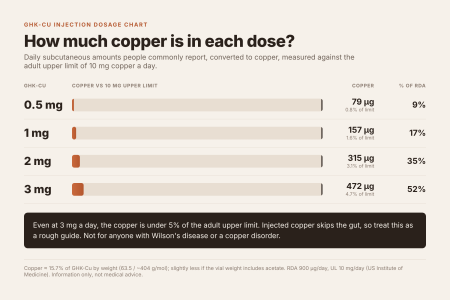
Even at 3 mg a day, the copper is under 5% of the adult upper limit. One medium cooked oyster contains more copper than a 3 mg injection.
The one thing worth knowing: injected copper skips your gut, which normally regulates how much you absorb, so treat the food comparison as a rough guide rather than a guarantee. And anyone with Wilson's disease or another copper-handling disorder should steer clear completely.
Starting dose. Most people begin at 0.5 to 1 mg a day for the first week or two. GHK-Cu can sting a little more than other peptides, so starting low lets you see how your skin handles the injection before stepping up.
Typical daily range. 1 to 2 mg a day is the sweet spot most users settle on. Some go up to 3 mg, though there's no evidence that more works better, so many people stay at 1 to 2 mg.
Frequency. Three schedules are popular:
Cycle length. Usually 4 to 12 weeks, followed by a similar break. One widely copied clinic protocol runs a 30-day cycle (a loading phase then a maintenance phase) followed by 30 days off.
Injection site. The belly is the go-to because it's quick and easy. Some people inject closer to the area they want to improve.
If you're working with a prescriber, follow their protocol. It's tailored to you in a way no forum chart can be.
Concentration (mg/mL) = mg in the vial ÷ mL of water added
A U-100 insulin syringe has 100 markings per millilitre, so each marking is 0.01 mL. Multiply your concentration by 0.01 and you know exactly what one marking holds.
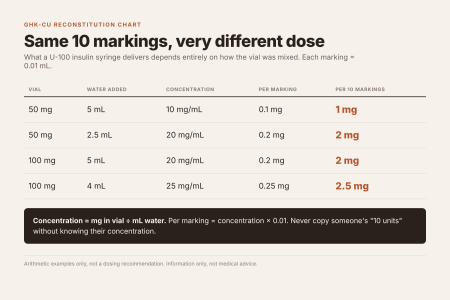
Here's the mistake to avoid. "10 units" means 1 mg in one vial and 2.5 mg in another. Always work from your own concentration, never someone else's number of units.
Two practical tips that come up constantly:
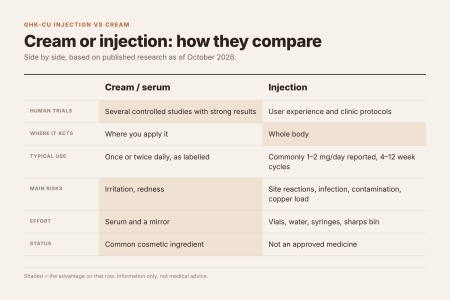
Both routes have a strong following, for different reasons.
Why people choose the cream. This is where the human clinical research lives. Topical GHK-Cu has been tested in controlled studies on real skin, with impressive results (more on those below). It's easy, cheap, low-risk, and it's a standard cosmetic ingredient you can buy anywhere.
Why people choose injections. GHK-Cu is a water-loving molecule, and your skin's outer layer is built to keep those out. That's why researchers keep developing liposomes and microneedles to push more of it through. Injecting skips that barrier completely and reaches the whole body, not just one patch of skin. That's the main appeal for anyone interested in recovery, hair, or the wider anti-ageing picture. The catch is that injection results come from user experience rather than published trials.
Why plenty of people do both. A common approach is a topical serum for the face plus injections for whole-body goals.
On topical strength, products vary a lot. The 2026 eyebrow trial used a 2% GHK-Cu serum twice daily, while a wound trial now recruiting uses a 0.1% gel. Follow your product's directions.
Collagen and firmer skin. This is where GHK-Cu really shines. In a 12-week study on thigh skin, GHK-Cu cream increased collagen production in 70% of women, against 50% for vitamin C cream and 40% for retinoic acid, the prescription-strength cousin of retinol.
Wrinkles and skin thickness. A 12-week facial study in 71 women with sun-damaged skin found thicker, denser skin, less sagging, improved clarity, fewer fine lines and shallower wrinkles. In a double-blind trial, GHK-Cu reduced wrinkle volume by about 32% more than Matrixyl 3000, one of skincare's best-known peptides, and by 56% compared with a control serum.
Wound healing. GHK-Cu's wound-healing reputation goes back decades, and a diabetic-ulcer study found better healing when a copper-peptide gel was added to standard care. A new Phase 2 trial (NCT07437586) began in February 2026, so more answers are on the way.
Hair. This is the exciting new frontier. In a randomised, double-blind trial published in 2026, 18 people applied 2% GHK-Cu serum to one eyebrow and a placebo to the other for 12 weeks. The GHK-Cu side grew more hairs, and thicker ones, with visible improvement in photos from week 4. Scalp hair loss hasn't had its own trial yet, but it's easy to see why so many people are trying it there.
The bigger picture. Anti-inflammatory, antioxidant, stem cell and gene-expression effects are all showing up in lab research. Most of that hasn't been tested in people yet, but it's the reason GHK-Cu keeps appearing in longevity discussions.
The early skin studies were small, and many came from Pickart's own research group, so independent confirmation is still building. But for a molecule your own body makes, it's a genuinely impressive track record.

Here's what to expect, based on how the studies actually ran:
When you compare photos, use the same lighting and angle each time and note anything else you're using. That way you can see exactly what GHK-Cu is doing for you.
With injections:
Who should avoid it: anyone with Wilson's disease or another copper metabolism disorder, anyone with a copper allergy, and pregnant or breastfeeding women, simply because it hasn't been studied in those groups.
As with any injection, good sterile technique matters. See a doctor promptly for spreading redness, heat or swelling, fever, or any swelling of the face or throat.
Injectable GHK-Cu has had a busier few years. In the US, the FDA placed it on its restricted "Category 2" compounding list in 2023. In April 2026 it came off that list, alongside other popular peptides such as BPC-157 and TB-500. That's a big shift in direction, though it isn't the same as approval. GHK-Cu still isn't an FDA-approved medicine, and an FDA advisory committee review is expected before the end of February 2027, so watch this space.
In the UK, copper tripeptide-1 is a common cosmetic ingredient, while injectable GHK-Cu isn't a licensed medicine. Elsewhere, check your local rules.
Injection users most commonly report 1 to 2 mg a day. Topical users apply once or twice daily. If you're under a prescriber, their protocol comes first.
How often should GHK-Cu be used?
Injections: daily or five days a week, in 4 to 12 week cycles. Topicals: once or twice a day.
What's a good starting dose?
0.5 to 1 mg a day when injecting, stepping up once you know how your skin reacts.
Is GHK-Cu better than retinol?
They're different tools and work well together. GHK-Cu is gentler, and in the one head-to-head collagen study it came out ahead of retinoic acid. Many people alternate them on different nights.
How long until I see results?
Most people notice changes between weeks 4 and 8, with the biggest improvements around week 12.
Have you used GHK-Cu? Post your experience below: cream or injection, how much, how long, and what you noticed. Real logs in one place make this thread more useful for everyone who finds it.
For information only, not medical advice. Injectable GHK-Cu is not an approved medicine. Speak to a qualified clinician before using any peptide.
The question everyone lands on sooner or later is the same one: how much should you actually use? That's what this thread is for. Below you'll find the GHK-Cu dosage ranges people really use, a chart showing what each dose means inside your body, how to mix a vial without guesswork, and an honest look at cream versus injection.
The short answer
- Injection: most users report 1 to 2 mg a day under the skin, often starting at 0.5 to 1 mg, run for 4 to 12 weeks with a break afterwards.
- Cream or serum: once or twice a day. This is how the clinical skin studies were done, with results typically measured at 12 weeks.
- The copper is tiny: a 2 mg dose carries around 0.3 mg of copper, about a third of what an adult needs each day from food.
- One thing to know upfront: injection doses come from clinic protocols and user experience rather than formal dosing trials, so it pays to understand the numbers properly. That's exactly what this post walks you through.
Why GHK-Cu has people so interested
GHK is a tiny peptide made of three amino acids: glycine, histidine and lysine. It circulates naturally in your blood, saliva and urine, and it latches onto copper, forming GHK-Cu. Here's the bit that grabs people: your levels fall as you age. Around age 20 there's roughly 200 ng/mL in your plasma. By 60 it's down to about 80.It was discovered in 1973, when Dr Loren Pickart noticed that something in young people's blood made aged liver tissue start producing proteins like young tissue again. That something turned out to be GHK.
Since then, research has linked it to:
- Building collagen, elastin and other skin structural proteins
- Faster, cleaner wound healing
- Calming inflammation and oxidative stress
- Stem cell activity in the skin
- Hair follicle support
The GHK-Cu peptide injection chart
Most dosage charts just list milligrams. Because GHK-Cu carries copper, the more useful question is how much copper you're actually taking in. The answer is reassuring.GHK-Cu is roughly 15 to 16% copper by weight. If your vial's stated weight includes acetate salt, as many do, the share is slightly lower still.
| GHK-Cu per day | Copper delivered | % of adult RDA (900 µg) | % of adult upper limit (10 mg) |
|---|---|---|---|
| 0.5 mg | ~79 µg | ~9% | ~0.8% |
| 1 mg | ~157 µg | ~17% | ~1.6% |
| 2 mg | ~315 µg | ~35% | ~3.1% |
| 3 mg | ~472 µg | ~52% | ~4.7% |
Even at 3 mg a day, the copper is under 5% of the adult upper limit. One medium cooked oyster contains more copper than a 3 mg injection.
The one thing worth knowing: injected copper skips your gut, which normally regulates how much you absorb, so treat the food comparison as a rough guide rather than a guarantee. And anyone with Wilson's disease or another copper-handling disorder should steer clear completely.
GHK-Cu dosage per day and frequency: what people actually do
These are the patterns that come up again and again in clinic protocols and user logs.Starting dose. Most people begin at 0.5 to 1 mg a day for the first week or two. GHK-Cu can sting a little more than other peptides, so starting low lets you see how your skin handles the injection before stepping up.
Typical daily range. 1 to 2 mg a day is the sweet spot most users settle on. Some go up to 3 mg, though there's no evidence that more works better, so many people stay at 1 to 2 mg.
Frequency. Three schedules are popular:
- Every day
- Five days on, two days off
- Two to three times a week at a slightly higher amount
Cycle length. Usually 4 to 12 weeks, followed by a similar break. One widely copied clinic protocol runs a 30-day cycle (a loading phase then a maintenance phase) followed by 30 days off.
Injection site. The belly is the go-to because it's quick and easy. Some people inject closer to the area they want to improve.
If you're working with a prescriber, follow their protocol. It's tailored to you in a way no forum chart can be.
How to mix a GHK-Cu vial (and read your syringe)
GHK-Cu usually comes as a freeze-dried (lyophilised) powder, often in 50 mg or 100 mg vials. Once you add bacteriostatic water, the maths is simple:Concentration (mg/mL) = mg in the vial ÷ mL of water added
A U-100 insulin syringe has 100 markings per millilitre, so each marking is 0.01 mL. Multiply your concentration by 0.01 and you know exactly what one marking holds.
| Vial | Water added | Concentration | Per marking | Per 10 markings |
|---|---|---|---|---|
| 50 mg | 5 mL | 10 mg/mL | 0.1 mg | 1 mg |
| 50 mg | 2.5 mL | 20 mg/mL | 0.2 mg | 2 mg |
| 100 mg | 5 mL | 20 mg/mL | 0.2 mg | 2 mg |
| 100 mg | 4 mL | 25 mg/mL | 0.25 mg | 2.5 mg |
Here's the mistake to avoid. "10 units" means 1 mg in one vial and 2.5 mg in another. Always work from your own concentration, never someone else's number of units.
Two practical tips that come up constantly:
- Mix it a bit more dilute if the injection stings. It's the most popular fix.
- Buy from a source that publishes third-party testing. A lot of injectable GHK-Cu online is labelled "research use only," and purity and fill accuracy vary widely between sellers.
GHK-Cu injection vs cream
Both routes have a strong following, for different reasons.
Why people choose the cream. This is where the human clinical research lives. Topical GHK-Cu has been tested in controlled studies on real skin, with impressive results (more on those below). It's easy, cheap, low-risk, and it's a standard cosmetic ingredient you can buy anywhere.
Why people choose injections. GHK-Cu is a water-loving molecule, and your skin's outer layer is built to keep those out. That's why researchers keep developing liposomes and microneedles to push more of it through. Injecting skips that barrier completely and reaches the whole body, not just one patch of skin. That's the main appeal for anyone interested in recovery, hair, or the wider anti-ageing picture. The catch is that injection results come from user experience rather than published trials.
Why plenty of people do both. A common approach is a topical serum for the face plus injections for whole-body goals.
On topical strength, products vary a lot. The 2026 eyebrow trial used a 2% GHK-Cu serum twice daily, while a wound trial now recruiting uses a 0.1% gel. Follow your product's directions.
GHK-Cu benefits: what the research shows
Collagen and firmer skin. This is where GHK-Cu really shines. In a 12-week study on thigh skin, GHK-Cu cream increased collagen production in 70% of women, against 50% for vitamin C cream and 40% for retinoic acid, the prescription-strength cousin of retinol.
Wrinkles and skin thickness. A 12-week facial study in 71 women with sun-damaged skin found thicker, denser skin, less sagging, improved clarity, fewer fine lines and shallower wrinkles. In a double-blind trial, GHK-Cu reduced wrinkle volume by about 32% more than Matrixyl 3000, one of skincare's best-known peptides, and by 56% compared with a control serum.
Wound healing. GHK-Cu's wound-healing reputation goes back decades, and a diabetic-ulcer study found better healing when a copper-peptide gel was added to standard care. A new Phase 2 trial (NCT07437586) began in February 2026, so more answers are on the way.
Hair. This is the exciting new frontier. In a randomised, double-blind trial published in 2026, 18 people applied 2% GHK-Cu serum to one eyebrow and a placebo to the other for 12 weeks. The GHK-Cu side grew more hairs, and thicker ones, with visible improvement in photos from week 4. Scalp hair loss hasn't had its own trial yet, but it's easy to see why so many people are trying it there.
The bigger picture. Anti-inflammatory, antioxidant, stem cell and gene-expression effects are all showing up in lab research. Most of that hasn't been tested in people yet, but it's the reason GHK-Cu keeps appearing in longevity discussions.
The early skin studies were small, and many came from Pickart's own research group, so independent confirmation is still building. But for a molecule your own body makes, it's a genuinely impressive track record.
GHK-Cu before and after
Here's what to expect, based on how the studies actually ran:
- Weeks 1 to 2: Early days. Some people notice their skin looks more hydrated or has a bit more glow.
- Weeks 4 to 8: This is when texture and tone usually start to visibly improve. In the eyebrow trial, photo scores were already better by week 4.
- Week 12: The point where most clinical studies record their headline results, and where the biggest changes tend to show.
When you compare photos, use the same lighting and angle each time and note anything else you're using. That way you can see exactly what GHK-Cu is doing for you.
GHK-Cu side effects
One of the reasons GHK-Cu is so popular is how well tolerated it tends to be. Most side effects are mild and short-lived.With injections:
- Redness, itching or a small raised welt at the site, usually gone within hours
- A brief sting during the injection
- Occasional bruising, as with any needle
- Mild irritation or redness, mostly when stacked with strong acids or retinoids
- Some users report the "copper uglies," a short spell of rougher skin when starting a strong copper product, which then settles
Who should avoid it: anyone with Wilson's disease or another copper metabolism disorder, anyone with a copper allergy, and pregnant or breastfeeding women, simply because it hasn't been studied in those groups.
As with any injection, good sterile technique matters. See a doctor promptly for spreading redness, heat or swelling, fever, or any swelling of the face or throat.
GHK-Cu reviews: what users are saying
User feedback leans strongly positive. The themes that come up most:- Smoother skin with more glow. The most common theme by far, usually from around week 4.
- Faster healing of small cuts and scars. Especially popular with people combining it with other recovery peptides.
- Firmer-looking skin. Mostly from users who stick with it for the full 12 weeks.
- Hair results are more mixed. Some users love it, others see little, which fits with hair research being at an early stage.
Is GHK-Cu legal?
Topical copper peptides are legal and widely sold in skincare almost everywhere.Injectable GHK-Cu has had a busier few years. In the US, the FDA placed it on its restricted "Category 2" compounding list in 2023. In April 2026 it came off that list, alongside other popular peptides such as BPC-157 and TB-500. That's a big shift in direction, though it isn't the same as approval. GHK-Cu still isn't an FDA-approved medicine, and an FDA advisory committee review is expected before the end of February 2027, so watch this space.
In the UK, copper tripeptide-1 is a common cosmetic ingredient, while injectable GHK-Cu isn't a licensed medicine. Elsewhere, check your local rules.
Quick FAQ
What dosage of GHK-Cu should I take?Injection users most commonly report 1 to 2 mg a day. Topical users apply once or twice daily. If you're under a prescriber, their protocol comes first.
How often should GHK-Cu be used?
Injections: daily or five days a week, in 4 to 12 week cycles. Topicals: once or twice a day.
What's a good starting dose?
0.5 to 1 mg a day when injecting, stepping up once you know how your skin reacts.
Is GHK-Cu better than retinol?
They're different tools and work well together. GHK-Cu is gentler, and in the one head-to-head collagen study it came out ahead of retinoic acid. Many people alternate them on different nights.
How long until I see results?
Most people notice changes between weeks 4 and 8, with the biggest improvements around week 12.
Final thoughts
GHK-Cu is one of the most interesting peptides out there. It's natural, it's backed by decades of research, it compares well against the big names in skincare, and new trials are finally arriving. If you want to start simple, a quality topical gives you the most proven route. If you're going the injection route, the dosage and mixing charts above will help you do it properly.Have you used GHK-Cu? Post your experience below: cream or injection, how much, how long, and what you noticed. Real logs in one place make this thread more useful for everyone who finds it.
For information only, not medical advice. Injectable GHK-Cu is not an approved medicine. Speak to a qualified clinician before using any peptide.
