


LEW
Administrator
Staff member
PEPTIGRAM, A Human Body Peptide Map. Anyone Else Going Down This Rabbit Hole?
I've been reading up on peptides for a while now, and one thing that's always frustrated me is how scattered the information is.You look up BPC-157 and end up reading about tendons. Then you come across MOTS-c and suddenly you're looking at mitochondria. Before you know it, you're reading about SS-31, blood vessels, growth hormone, metabolism and half a dozen things you weren't even searching for in the first place.
Hi, I'm Lew, 55, based in the UK, and my main interests are cardiovascular health, endurance, keeping muscle on as I get older, managing body fat and hopefully staying fit enough to enjoy the next 20 or 30 years.
I'm not particularly interested in looking 25 again. I'd rather be 70 and still able to walk up a decent hill without feeling like I need an ambulance.
Anyway, I've been putting together something called PEPTIGRAM.
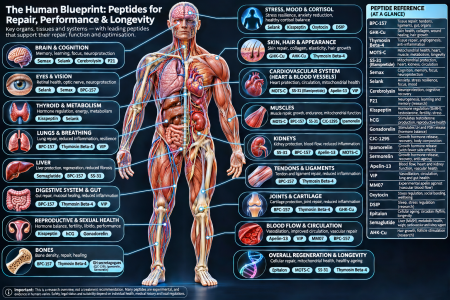
The idea is fairly simple: a human anatomy chart showing which peptides are being investigated for different parts of the body.
Brain, heart, blood vessels, muscles, tendons, liver, kidneys, skin, hormones, the lot.
The ones that caught my attention
The cardiovascular and mitochondrial side is probably what interests me most.MOTS-c is one I've spent a fair bit of time reading about as well as usage of course. The research around cellular energy regulation and metabolism is fascinating, particularly when you start thinking about endurance and what happens to our metabolic health as we get older.
SS-31 (elamipretide) is another interesting one. It targets mitochondrial function, and unlike many of the peptides being discussed online, it has actually reached clinical use in the US for a specific rare condition, Barth syndrome. I have been using it regular along side MOTS-c and i am already experiencing very positive changes with the my cardio i do on my bike which not only show in the way i feel physically, eg stronger riding, better endurance, better recovery but also the numbers i am seeing on my garmin such as HRV, RHR are extremely favourable! (Not to mention the excellent BP!)
For body composition, semaglutide, tirzepatide, or retatrutide are in a different league when it comes to the amount of human clinical research available. There is also evidence of cardiovascular benefit in certain patient groups. It isn't a muscle-building drug, though, and maintaining muscle while losing weight is a separate challenge.
On the muscle and recovery side, CJC-1295, ipamorelin and sermorelin crop up constantly in discussions about growth hormone. They're interesting from a hormonal signalling perspective, with claims about muscle growth, recovery and anti-ageing cited often.
And obviously there's BPC-157.
You can hardly read a peptide forum without seeing it mentioned. Tendons, ligaments, gut, recovery, it's discussed for just about everything. Some of the animal research is intriguing and certainly reflected within the research studies that many of us are involved in with it.
Why I wanted to make Peptigram
What I really wanted was somewhere I could look at the human body and quickly see:- Which peptides are being studied for a particular organ or tissue?
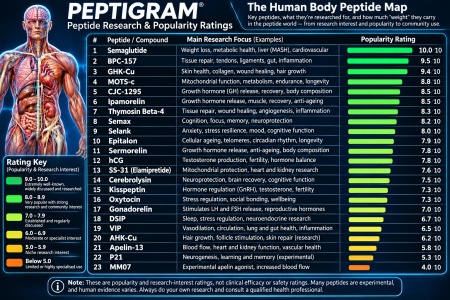
- Which ones are genuinely well researched?
- Which ones are popular mainly because everyone online keeps talking about them?
- Where does the science look promising, and where are people getting carried away?
The chart currently covers 23 different compounds, including GHK-Cu, thymosin beta-4, Semax, Selank, kisspeptin, Epitalon, VIP and several others.
I'm also planning straightforward write-ups for each one, without pages of unnecessary technical jargon.
What interests me most at 55
Personally, I keep coming back to five things.Heart health. Not just avoiding problems, but understanding what might support cardiovascular function as we age.
Endurance. Keeping the engine running. Walking, cycling, training and generally not running out of steam.
Muscle retention. I reckon maintaining strength becomes increasingly important once you're past 50.
Metabolic health and weight. Staying reasonably lean without sacrificing muscle or energy.
Longevity. Not simply adding years, but hopefully adding years where you're still capable of doing the things you enjoy.
And for all the excitement around peptides, I'm certainly not overlooking the boring stuff: blood pressure, cholesterol, exercise, sleep, diet and keeping an eye on blood sugar. Those have far more established benefits than most experimental compounds.
Interested to hear what others think
Has anyone else been looking particularly closely at MOTS-c, SS-31 or the cardiovascular side of peptide research?I'm also curious whether people think BPC-157 deserves its enormous reputation, or whether the online discussion has got a bit ahead of itself.
And if you were building a Peptigram reference chart, what compounds would you add?
I'd especially like to hear from anyone over 45 or 50 who's interested in endurance, cardiovascular health and longevity rather than purely bodybuilding.
There's a lot of noise around peptides at the moment. It would be good to separate the genuinely interesting science from the marketing.
Cheers.
Lew