

Retatrutide: The Triple-Action Peptide Behind Remarkable Weight-Loss Results
Human clinical trials are producing some extraordinary findings. Here’s why retatrutide has become one of the most talked-about developments in obesity research.Human clinical evidencePhase 3 results reportedInvestigational medicine
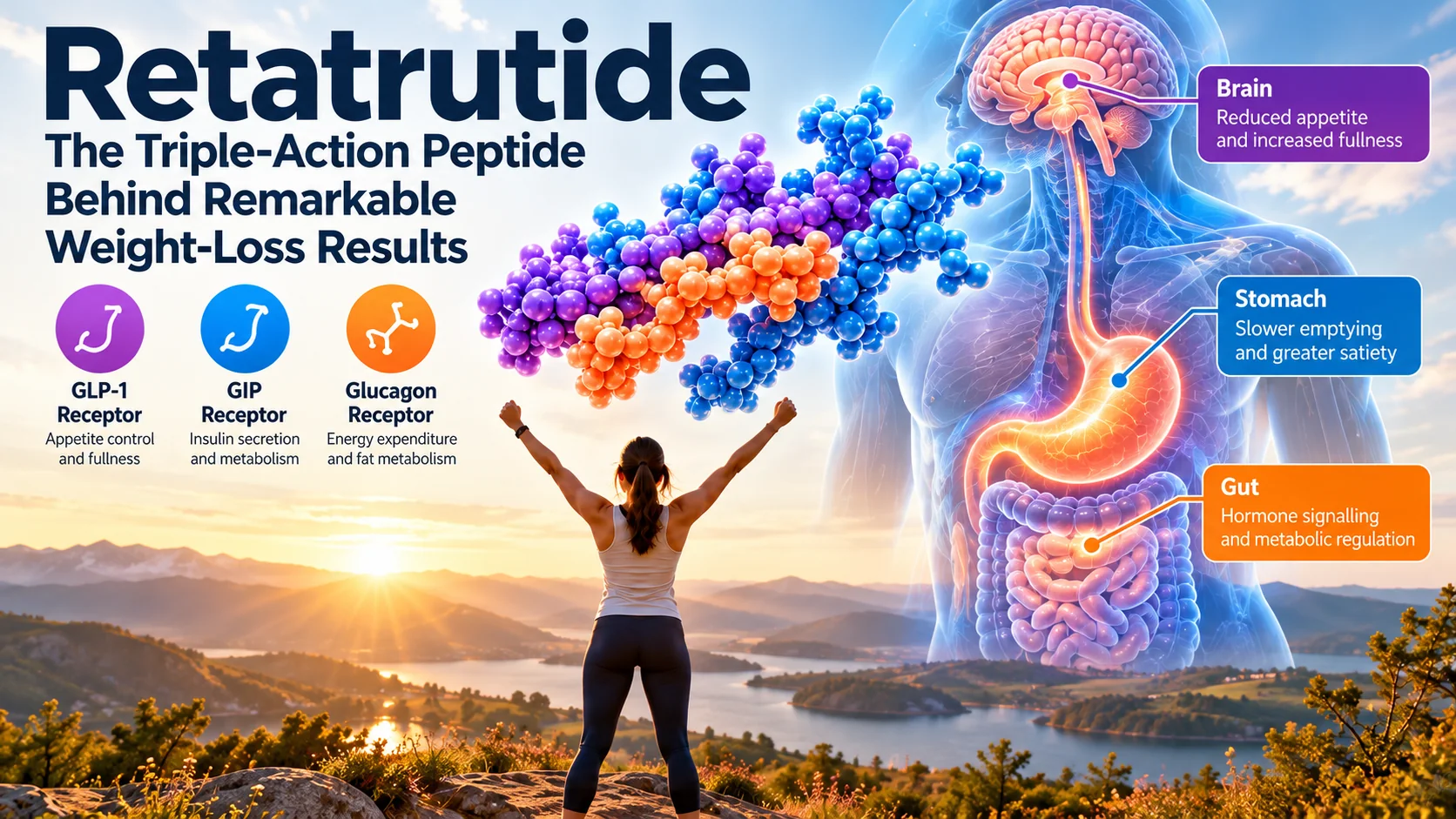
Conceptual AI-generated illustration. Molecular and anatomical elements are not verified structural or medical diagrams.
Imagine a treatment that targets not one hormone pathway, or even two, but three. That’s the idea behind retatrutide, an experimental peptide developed by Eli Lilly.
Unlike many experimental peptides discussed online, retatrutide already has substantial human trial evidence. In a published Phase 2 study, the highest-dose group lost an average of 24.2% of starting body weight over 48 weeks. Lilly later reported 28.3% average weight reduction over 80 weeks in a Phase 3 study. These are remarkable group results, not guarantees for individuals.
What exactly is retatrutide?
Retatrutide, also known as LY3437943, is an investigational peptide being studied for obesity and related metabolic conditions. It is a triple receptor agonist: one molecule designed to activate three hormone receptors involved in appetite and energy balance.GLP-1Appetite, fullness and blood glucose regulation
GIPInsulin secretion and metabolic regulation
GlucagonGlucose and energy metabolism; potential energy-expenditure effects
Researchers are testing whether acting on all three pathways together can produce powerful weight-management effects. The mechanisms are still being studied, and the illustration above is conceptual rather than a scientifically verified molecular structure.
Why is everyone so excited?
Because the results are coming from human clinical trials, not only animal experiments or online claims. In a published Phase 2 study, the 12 mg group had an average 24.2% weight reduction at 48 weeks. In May 2026, Eli Lilly announced an average 28.3% reduction at 80 weeks for the 12 mg group in the Phase 3 TRIUMPH-1 study.Those are group averages, not guarantees for an individual. Even so, the scale of weight reduction is a compelling reason for scientific interest.
What have human trials actually shown?
Published Phase 2 trial · 48 weeks
A randomised, double-blind, placebo-controlled study enrolled 338 adults with obesity or overweight and a weight-related condition. The figures below are the reported mean percentage changes in body weight at week 48.Published Phase 2 results — Jastreboff and colleagues, 2023
| Study group | Average change |
|---|---|
| Placebo | −2.1% |
| Retatrutide 4 mg (combined) | −17.1% |
| Retatrutide 8 mg (combined) | −22.8% |
| Retatrutide 12 mg | −24.2% |
Phase 3 TRIUMPH-1 · 80 weeks
In May 2026, Lilly reported the following results for the TRIUMPH-1 obesity trial:Company-announced Phase 3 results — May 2026
| Study group | Average weight reduction |
|---|---|
| Retatrutide 4 mg | 19.0% |
| Retatrutide 9 mg | 25.9% |
| Retatrutide 12 mg | 28.3% |
How to read the numbers: Different studies, durations and analyses cannot be compared as though they were one head-to-head experiment. These averages do not predict any one person’s response.
Beyond weight loss: what else is being studied?
Retatrutide research is exploring more than the number on the scales. Lilly’s June 2026 Phase 3 announcements described improvements in blood glucose, knee osteoarthritis symptoms and obstructive sleep apnoea in relevant trial populations.These findings are encouraging, but substantial weight loss itself can improve several obesity-related conditions. Researchers must still disentangle effects related to weight reduction from any additional direct biological effects.

Around the Café: why people are talking
Retatrutide has sparked lively conversations about appetite, the possibility of substantial weight loss and how triple-receptor treatments might compare with established obesity medicines. There are also understandable questions about nausea, rapid weight change, muscle preservation, costs and what happens when treatment ends.For context on another approach to metabolic treatment, explore our Tirzepatide guide. Tirzepatide targets two hormone receptors, while retatrutide is being investigated as a triple-receptor agonist. That difference alone does not establish which treatment is better.
We can discuss those interests without presenting anonymous posts as verified medical outcomes. Online accounts are not clinical evidence, and substances sold under an investigational peptide’s name may not match the material used in regulated studies.
What about side effects and safety?
The published Phase 2 study found that gastrointestinal effects which included nausea, vomiting and diarrhoea were the most common adverse events. They were dose-related and generally mild to moderate in that study; a lower starting dose reduced some effects. Researchers also reported dose-dependent heart-rate increases that peaked and then declined during the trial.Longer-term questions include tolerability, treatment discontinuation, weight regain, nutrition, lean-mass preservation and uncommon adverse effects. Strong efficacy data do not mean a medicine is risk-free or appropriate for everyone.
UK status and what remains unknown
Retatrutide remains an investigational medicine in the clinical-trial announcements discussed here. Its current licensing status should be checked against official MHRA records before and after publication as the regulatory situation evolves.Peptide Cafe does not sell peptides, recommend suppliers or encourage self-experimentation. Products advertised online as “research retatrutide” should not be assumed to match the quality, identity or controls of clinical-trial medicines.

The positive experience-led view
Guinea Pig Gary Has His Say 

Real conversations, told with enthusiasm.Well, would you LOOK at the excitement around this one! Retatrutide discussions are full of people describing major changes in appetite and weight, and that makes this guinea pig sit up straight.
One public Reddit poster reported moving from about 307 to 284 pounds while describing substantially reduced hunger. They also reported severe nausea at the beginning and later fatigue. Another person described losing about 70 pounds since June 2025 and feeling pleased with the weight change, while also struggling with persistent nausea and mood-related symptoms. That's the thing about a real experience: even an exciting result can come with difficulties worth hearing about.
My favourite part of the conversation is what those accounts mean to the people telling them. When someone shares progress after struggling with their weight, you can hear the excitement. And unlike many peptides discussed around the café, retatrutide has controlled human trials showing substantial average weight reduction. That makes the research story especially compelling!
Of course, these anonymous online posters were not independently verified as clinical-trial participants, and the identity of what they used cannot be confirmed. I'm reporting what they said, not claiming their experiences are proof of a product's safety or authenticity. But the optimism is real, and I want you to hear it!
Public accounts behind this section
- Reddit: reported weight change and appetite experience
- Reddit: reported weight loss with ongoing side effects
REMARKABLE RESEARCH. EXTRAORDINARY POSSIBILITIES.
The Peptide Cafe Perspective
A new chapter in metabolic medicine — and one of the most exciting peptide research stories we've explored.Every so often, a scientific development comes along that makes you sit up, put down your coffee and pay attention. For us, retatrutide is one of those developments.
We've explored peptides with fascinating laboratory results, encouraging animal experiments and enthusiastic communities sharing their experiences.
But retatrutide brings something particularly exciting to the table: substantial weight-loss findings from controlled human clinical trials.
The results reported so far are remarkable, and we think they deserve genuine enthusiasm.
The results that really caught our attention
In the published 2023 Phase 2 clinical trial, participants receiving the 12 mg dose experienced an average 24.2% reduction in starting body weight over 48 weeks.That's an extraordinary finding in the context of obesity research.
And the story didn't stop there.
In May 2026, Eli Lilly announced that participants receiving the 12 mg dose in its Phase 3 TRIUMPH-1 trial achieved an average 28.3% weight reduction over 80 weeks.
The company also reported that 45.3% of participants in that group lost at least 30% of their starting body weight.
Just imagine the excitement among researchers following those results.
These figures represent group averages and company-reported trial findings, not promises about individual outcomes. The Phase 3 results should also be distinguished from fully published, independently assessed trial data.
But their scale gives us a compelling reason to follow this research closely.
Three hormone pathways. One fascinating approach.
Another reason we're so enthusiastic about retatrutide is the science behind its development.Rather than activating just one hormonal pathway, retatrutide is designed to act on three receptors:
GLP-1 — Appetite and fullness signalling GIP — Insulin and metabolic regulation Glucagon — Glucose and energy metabolism
It's an ambitious and fascinating approach to metabolic medicine.
Researchers are investigating whether activating these pathways together can achieve effects beyond those of existing therapies.
We find that particularly exciting because it demonstrates how decades of research into naturally occurring hormones can inspire entirely new therapeutic strategies.
And the potential may extend beyond weight loss
One of the most fascinating aspects of retatrutide is that researchers are investigating several obesity-related conditions alongside body-weight reduction.Clinical development programmes have examined outcomes involving blood glucose regulation, knee osteoarthritis symptoms and obstructive sleep apnoea.
Company-reported Phase 3 findings in 2026 described encouraging improvements in these areas.
That's exciting because obesity can affect many aspects of health and everyday life.
The possibility of a therapy producing meaningful improvements across several related outcomes deserves serious attention.
Of course, substantial weight loss itself can improve many of these conditions. Researchers still need to establish which effects result from weight reduction and whether the treatment produces additional benefits through other mechanisms.
But the opportunity to investigate those questions is genuinely fascinating.
The human side of the excitement
Behind every clinical trial statistic are people hoping for better health, greater mobility and improved quality of life.That's an important part of why retatrutide has attracted so much interest.
In online conversations, people discuss the possibility of substantial weight reduction, changes in appetite and what emerging triple-receptor medicines could mean for the future of obesity treatment.
There is genuine enthusiasm about the research.
And we understand why.
For someone who has struggled with obesity or an obesity-related condition, the prospect of additional evidence-based treatment options can be enormously meaningful.
We welcome that optimism.
At the same time, personal accounts involving substances described online as retatrutide cannot automatically be treated as experiences with the regulated clinical-trial medicine.
The strongest reason for our excitement remains the controlled human research.
Imagine where metabolic medicine could go next
Perhaps the most exciting thing about retatrutide is what it could teach scientists about the future of metabolic treatments.Could triple-receptor medicines provide meaningful benefits for more people living with obesity?
Might future research reveal advantages for particular metabolic conditions?
Could scientists develop even more targeted therapies using what they learn from these trials?
And could longer-term studies help establish how best to balance effectiveness, tolerability and lasting health outcomes?
These are big questions, and we are enthusiastic about seeing them answered.
Retatrutide is still investigational in the research discussed here, and its long-term safety, regulatory status and individual suitability require careful assessment.
Yet the scientific progress already demonstrated makes this a particularly compelling area to watch.
 What makes retatrutide so exciting?
- Remarkable human clinical trial findingsPublished Phase 2 research and company-reported Phase 3 results have demonstrated substantial average weight reductions.
- Innovative triple-receptor scienceIts GLP-1, GIP and glucagon receptor activity represents an intriguing direction in metabolic medicine.
- Potential benefits beyond weight lossClinical programmes are investigating several obesity-related health outcomes, with encouraging findings reported.
- An exciting future for metabolic researchLonger studies could help answer important questions about lasting benefits, safety and future treatment possibilities.
Science, experiences, claims and curiosity are all welcome at the Peptide Cafe.
Original research & further reading
- Jastreboff AM, et al. (2023). Triple–Hormone-Receptor Agonist Retatrutide for Obesity — A Phase 2 Trial. New England Journal of Medicine. Original paper ↗
- Eli Lilly (21 May 2026). Lilly’s triple agonist, retatrutide, delivered powerful weight loss in pivotal Phase 3 obesity trial. Company announcement ↗
- Eli Lilly (6 June 2026). Retatrutide drove substantial improvements in weight, A1C, knee osteoarthritis pain and obstructive sleep apnoea. Company announcement ↗
From the Café
Martin LewisResearched and written by Martin Lewis, Peptide Cafe.
This guide is educational, not medical or legal advice, and does not recommend self-experimentation or purchasing peptides.