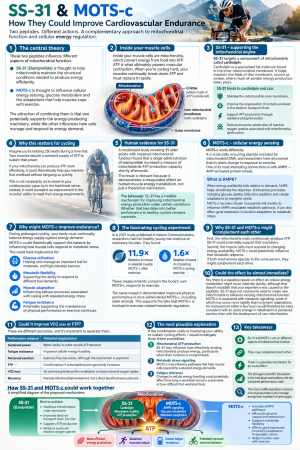

SS-31 + MOTS-c: The Science Behind the Combination
Currently exploring this idea.So, the science behind using them both
The central theory is that these two peptides influence different aspects of mitochondrial function.- SS-31 (Elamipretide) is thought to help mitochondria maintain the structural conditions needed to produce energy efficiently.
- MOTS-c is thought to influence cellular energy sensing, glucose metabolism and the adaptations that help muscles cope with exercise.
Inside your muscle cells are mitochondria, which convert energy from food into ATP.
ATP is what ultimately powers muscular contraction. When you're cycling hard, your muscles continually break down ATP and must replace it rapidly.
1. SS-31: How it works
SS-31 targets a component of mitochondria called cardiolipin.Cardiolipin is a specialised fat molecule found in the inner mitochondrial membrane. It helps maintain the folds of that membrane, known as cristae, where much of aerobic energy production takes place.
SS-31 binds to cardiolipin and will:
- Stabilise the mitochondrial inner membrane.
- Improve the organisation of proteins involved in the electron transport chain.
- Support ATP production through oxidative phosphorylation.
- Reduce excessive production of reactive oxygen species associated with mitochondrial dysfunction.
Why this matters for cycling
Imagine you're holding 250 watts during a time trial.Your muscles require a constant supply of ATP to sustain that power.
If your mitochondria can produce ATP more effectively, it could theoretically help you maintain that workload without fatiguing as quickly.
This is not necessarily an increase in your cardiovascular capacity in the traditional sense. Instead, it could represent an improvement in the muscles' ability to meet their energy requirements.
The particularly interesting human evidence
A randomised study involving 39 older adults with impaired mitochondrial function found that a single administration of elamipretide increased a measure of mitochondrial ATP production capacity shortly afterwards.The result is relevant because it demonstrates a measurable effect on human muscle energy metabolism, not just a theoretical mechanism.
The takeaway: SS-31 has a credible mechanism for improving mitochondrial energy production under certain conditions. Whether that translates into better performance in healthy cyclists remains uncertain.
2. Now, as for MOTS-c... MOTS-c works differently
It is a naturally occurring peptide encoded by mitochondrial DNA, and researchers have discovered that its levels change in response to exercise.One of its most interesting connections is with AMPK — AMP-activated protein kinase.
What is AMPK?
When energy availability falls relative to demand, AMPK helps coordinate the response.It influences processes including glucose uptake, fatty-acid oxidation and cellular adaptations to energetic stress.
MOTS-c has been shown in experimental models to influence AMPK-associated metabolic pathways. It can also affect gene expression involved in adaptation to metabolic stress.
Why might that improve endurance?
During prolonged cycling, your body must continually balance energy supply against energy demand.MOTS-c could theoretically support this balance by influencing how muscle cells respond to metabolic stress.
This could have implications for:
- Glucose utilisation: Helping cells manage an important fuel for moderate- and high-intensity exercise.
- Metabolic flexibility: Supporting the ability to respond to different fuel demands.
- Muscle adaptation: Influencing cellular processes associated with coping with repeated energy stress.
The fascinating cycling experiment
In a 2021 study published in Nature Communications, researchers had ten healthy young men exercise on stationary bicycles.They found:
11.9×
Skeletal muscle MOTS-cRelative increase after exercise
1.6×
Circulating MOTS-cRelative increase during exercise
These measurements concern the body's own MOTS-c response to exercise.
The same research demonstrated improved physical performance in mice administered MOTS-c, including older animals.
This supports the idea that MOTS-c is involved in exercise-related metabolic regulation.
3. Why SS-31 and MOTS-c might complement each other
This is the central theory behind the combination.First, the mitochondria must continuously produce ATP. SS-31 could potentially support that machinery.
Second, the muscle cells must respond to changing energy availability. MOTS-c could potentially influence that metabolic response.
If both mechanisms operate in the same person, they might complement each other.
4. Could the effect be almost immediate?
Yes, there is a plausible reason an effect on cellular energy metabolism might occur relatively quickly, although that doesn't establish that your experience was caused by the peptides.SS-31 does not necessarily need to create new mitochondria to influence existing mitochondrial function. Its interaction with the inner mitochondrial membrane could affect the performance of existing machinery.
The human ATP-production study detected a change following a single administration.
MOTS-c is associated with metabolic signalling, some of which may occur more rapidly than long-term adaptations such as mitochondrial biogenesis.
An improvement within a few hours would therefore be more consistent with an acute change in metabolism or perceived exertion than with the development of new mitochondria.
That's a mechanistic possibility, not a demonstrated explanation.
5. Could it improve VO2 max or FTP?
These are different outcomes, and it's important to separate them.| Performance measure | Potential explanation |
|---|---|
| Sustained power | Better ability to meet muscle ATP demand |
| Fatigue resistance | Improved cellular energy handling |
| Perceived exertion | Exercise may feel easier, although the mechanism is unproven |
| FTP | Could improve if sustainable power genuinely increases |
| VO2 max | No convincing evidence the combination increases maximal oxygen uptake |
| Recovery | Possible mitochondrial involvement, but a direct benefit remains unproven |
6. So what is the most plausible explanation for your experience?
If the combination really is improving your ability to sustain cycling efforts, I would investigate three linked possibilities:First: Mitochondrial ATP production. SS-31 may influence how effectively existing mitochondria produce energy, particularly when their function is compromised.
Second: Metabolic stress signalling. MOTS-c may influence pathways that help muscle cells respond to sustained energy demands.
Third: Fatigue tolerance. Changes in cellular energy handling could potentially affect how long a workload remains sustainable or how difficult that workload feels.
The strongest scientific foundation is the individual mechanisms, not the combined performance claim.
The more credible hypothesis concerns how muscles produce and manage energy from available fuel and oxygen.