


LEW
Administrator
Staff member
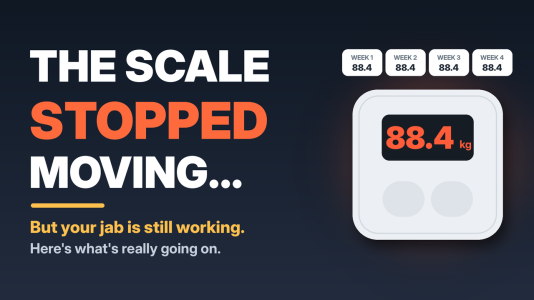
The short version
- Your jab has not stopped working.
- Your body is fighting back, mostly by making you hungrier.
- The jab is still holding the weight off. That's why people who stop it usually put weight back on.
The scale has stopped moving. Now what?
For months, the jab worked. The weight came off. Your clothes got looser.
Then it stopped. Week after week, the same number.
So you start to worry. Has the jab stopped working?
Good news. It almost certainly hasn't. Your body has started to fight back. Doctors call this metabolic adaptation.
That sounds complicated. It isn't. I'll explain it with a car.
Your body is like a car
- The fuel tank is your body fat. It's your spare energy.
- The engine is your muscles. They burn the fuel.
- The car's computer is your brain. It watches the fuel gauge all day long.
- The fuel light is your hunger. It tells you to fill up.
Your brain has one big job: don't run out of fuel.
It doesn't know you want to lose weight. When it sees the tank going down, it gets worried. So it starts changing how the car works.
Those changes are metabolic adaptation. There are three of them.
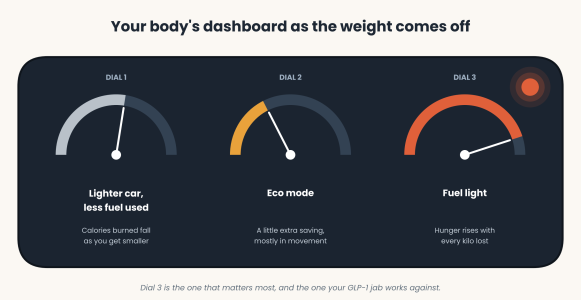
Change 1: A lighter car needs less fuel
A small car uses less petrol than a big van.
Your body is the same. When you weigh less, you burn less.
So the food that made you lose weight at the start might only keep you steady now. Nothing is wrong. You've just got smaller.
Change 2: The engine goes into "eco mode"
Your body gets a bit more careful with its fuel. It does the same jobs but uses a little less.
This is real. But it's smaller than most people think.
And the jab doesn't make it worse. Studies suggest eco mode on a jab is about the same as on any diet.
Change 3: The fuel light gets brighter (the big one)
This is the most important part.
As you lose fat, your brain turns up your hunger. Every bit of weight you lose makes the fuel light shine a little brighter.
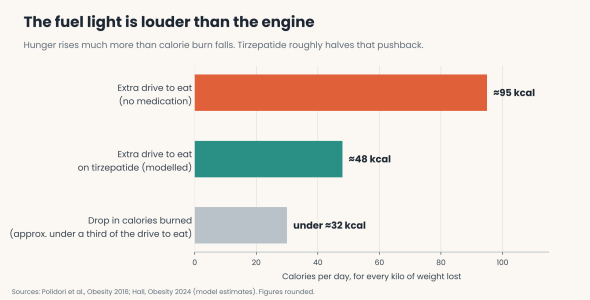
How much brighter? Scientists have worked it out. For every kilo you lose, your body wants about 100 more calories a day. That's about a slice of toast.
That adds up fast. Lose three stone, and your body wants close to 2,000 extra calories a day. That's nearly a whole extra day of food.
This hunger push is about three times stronger than eco mode. That's why diets on their own stop working.
What the jab actually does
Think of Mounjaro or Wegovy as tape over the fuel light.
It dims your hunger. That's why the "food noise" goes quiet.
Studies suggest the jab cuts your body's hunger push roughly in half. So you keep losing weight for much longer than you would on a diet alone.
But the tape can't hide the light completely. That's a good thing. If you never felt hungry at all, you could get very ill.
So, bit by bit, the light gets bright enough to shine through the tape. That's your plateau.
The jab is still working. Your body is pushing back just as hard.
When does the plateau usually come?
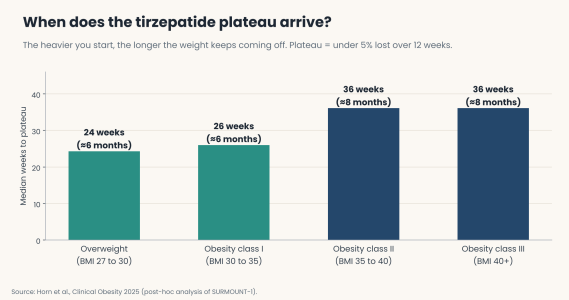
In the big Mounjaro trials, most people hit their plateau somewhere between 6 and 8 months.
People who started off heavier usually kept losing for longer.
By about 17 months, nearly 9 in 10 people had reached their plateau.
How do we know the jab is still working?
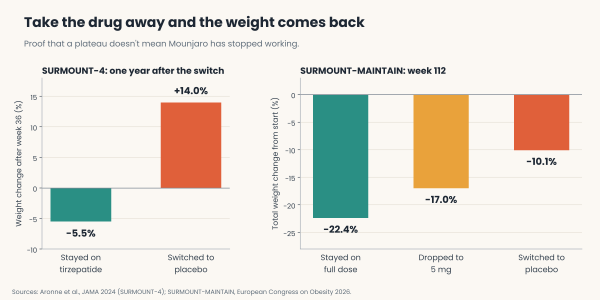
Simple. Scientists took it away.
In one big trial, people took Mounjaro for about 8 months. Then half of them were secretly switched to a fake jab.
- The people who stayed on Mounjaro lost a bit more weight.
- The people who stopped put a lot of it back on within a year.
A newer trial in 2026 found the same thing. Even people who had already hit their plateau put weight back on when they stopped.
If the jab had really stopped working, stopping it wouldn't change anything. But it does.
Look after your engine (your muscles)
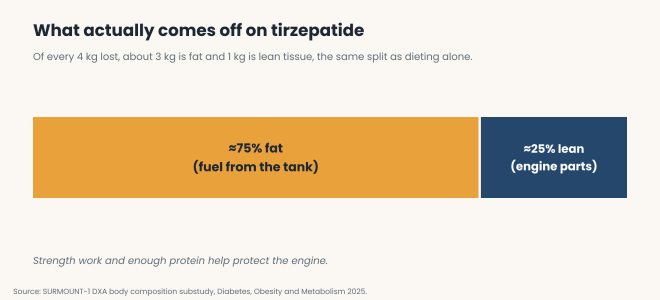
When you lose weight, you lose some muscle too. About a quarter of the weight that comes off is muscle and other lean tissue.
That's normal. It happens on any diet.
But a smaller engine burns less fuel. So it's worth looking after.
What can you do?
- Do some strength exercise. Two or three times a week. Squats, resistance bands or light weights are fine.
- Eat your protein first. Meat, fish, eggs, yoghurt or beans. Put them on your plate before anything else.
- Walk more. All the little bits of moving add up.
- Watch the snacking. Small nibbles creep back in without you noticing.
- Don't miss doses. Gaps let the hunger come back.
- Speak to your prescriber before you change your dose or stop. Only get your jab from a proper UK pharmacy.
- Look at the bigger picture. If your weight is steady but your waist, blood sugar and blood pressure are better, that's a win.
This is general information, not medical advice. Talk to your doctor or prescriber about your own treatment.
Quick questions
Has my jab stopped working?
Almost certainly not. Your body has just caught up with it.
Have I built up a tolerance?
A little. The "full after a few mouthfuls" feeling fades after the first few weeks. But the jab still turns your hunger down.
When will I plateau?
Most people in the trials plateaued between 6 and 8 months.
I hardly lost anything in the first 3 months. Will it still work?
It might. In one trial, 9 in 10 slow starters had lost at least 5% of their weight by about 17 months.
Will my metabolism go back to normal?
Not always. That's one reason doctors now see these jabs as long-term medicines.